
Louisville, Kentucky — Gastroparesis Surgery
More gastroparesis surgeries than any surgeon in the world.
Dr. Michael Hughes has placed more than 2,500 gastric stimulators and performed more than 2,000 pyloroplasties. Vanguard treats gastroparesis and nothing else — medically as well as surgically — so the recommendation you get is the one that actually fits you.
Vanguard Surgical, LLC
Location
2401 Terra Crossing Blvd, Suite 375
Louisville, KY 40245
Phone
Hours
Monday–Friday, 8:00 am – 4:00 pm ET
Free weekly seminar
Tuesdays, 6:00–7:00 pm ET · online
2,500+
Gastric stimulators placed
2,000+
Pyloroplasties performed
<0.5%
Pyloroplasty leak rate
1
Disease. That's the whole practice.
Career totals as of 2026. Individual results vary; no surgical outcome can be guaranteed.
Free · Every Tuesday · 6–7pm ET · Online
Understand your disease before you decide anything.
A free one-hour seminar, online, open to anyone anywhere. Not a consultation, not telehealth, not a sales pitch. You do not need to live in Kentucky or Indiana, and attending commits you to nothing.
What gets covered
- How a normal stomach works, and what the pylorus does
- Why your stomach is under pressure — and why that, not slow emptying, causes most of what you feel
- Diet, medication, and both operations
- Recovery, risks, and honest numbers
The one thing worth understanding
Two patients. The same nausea. Different operations.
The nausea comes from the vagus nerve — think of it as a smoke alarm wired to your stomach. What tells the two situations apart isn't a test. It's the company the nausea keeps.
one-stop care
Medical and surgical management.
Most practices that treat gastroparesis do one or the other. A practice that only operates will steer you toward the operating room.
Here, medication is a real option rather than a formality on the way to surgery. Most patients are managed medically first. Surgery is what happens when medication has genuinely been given its chance.
For referring physicians: one referral covers the whole pathway. Diet, medication and both operations are handled here, so the patient doesn't come back to you needing to be sent somewhere else.
The treatment sequence
- Dietary modification — what it can and cannot do
- Medical management — prokinetics, antiemetics, antacids
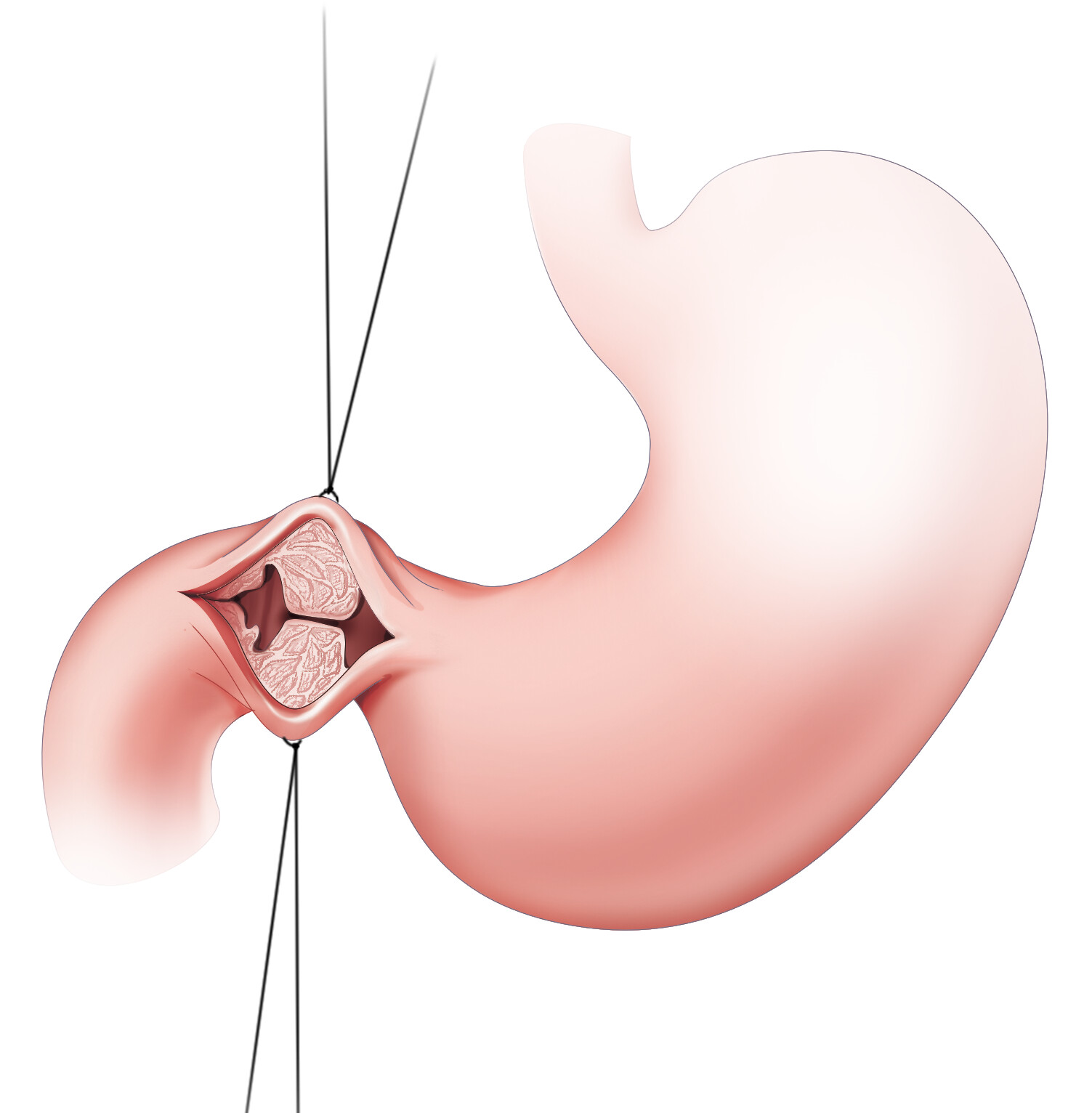
- Pyloroplasty — for a stomach under pressure
- Gastric stimulation — for nausea that travels alone
The two operations
Both are laparoscopic, both are outpatient, and patients go home the same day.

How this practice is different
Gastroparesis is the whole practice
Most surgeons who treat gastroparesis treat many other things, and these patients end up as the difficult cases wedged between more straightforward work. Here they are the entire practice.
Private practice, not university
No trainees managing your care. You are seen by the surgeon who will operate on you, and by the nurse practitioner who will manage your medication.
Outpatient surgery center
Both operations are done at an ambulatory surgical center — lower cost than a hospital, lower infection rates, and home the same day.
He teaches other surgeons
Dr. Hughes trains and advises other surgeons on stimulator placement and management on behalf of Enterra Medical, the device's manufacturer.
The team
Five people, one disease. You will get to know all of them.
Michael G. Hughes Jr., MD
President & Attending Surgeon
Left a professorship and three directorships at the University of Louisville in 2019 to build a practice devoted entirely to gastroparesis.
Taylor Rich, APRN
Nurse Practitioner
Joined in 2023 and assists with medical management. More than a decade of emergency and endoscopy nursing at UofL Health before that.
Phyllis Kaiser, R.N.
Registered Nurse
Has worked alongside Dr. Hughes for over 10 years. A former transplant nurse coordinator with 25+ years in organ donation, critical care and surgery.
Michelle Sinclair, MA
Office Manager
More than 20 years in healthcare, with a personal understanding of how this disease affects daily life.
Michaela Freeland
Medical Office Associate
With Vanguard since the practice opened, and the first person most patients speak to.
What patients say
“Thank you, Dr. Hughes, for being such an awesome champion for us GP sufferers. After struggling with GP for 20+ years, I am SO thankful to FINALLY have someone in my corner that can help.”
Jessica — pyloroplasty and gastric stimulator placement
“It's been a long journey! I haven't felt this good in the stomach for 5 years! Thank you for fighting the insurance and helping my stomach empty! A life-changing procedure.”
Adrianne — pyloroplasty
For healthcare providers
Refer a patient
Digital referral, or a downloadable form. Dr. Hughes handles peer-to-peer reviews himself when a procedure is denied, and appeals on the patient's behalf where necessary.
Who to send
- Nausea and vomiting despite diet and medication
- Bloating, fullness and upper abdominal pain
- Failed G-POEM or prior pyloric intervention
- Patients you'd rather not manage long-term yourself
Start with the seminar. Decide afterwards.
One hour, online, free, and it commits you to nothing. You do not need to live in Kentucky or Indiana.
Questions? Call (502) 912-8300, Monday–Friday 8:00 am – 4:00 pm ET.